Our group member, Guangyu Zhu, has successfully defended his Ph.D. dissertation titled: Hierarchical Membrane Synthesis and Transport Phenomenon for Desalination and Resource Recovery from Hyper-Brine Wastewater. Guangyu’s doctoral research focused on induction-heated membrane distillation, omniphobic membrane engineering, and sustainable desalination technologies for challenging water-treatment applications.
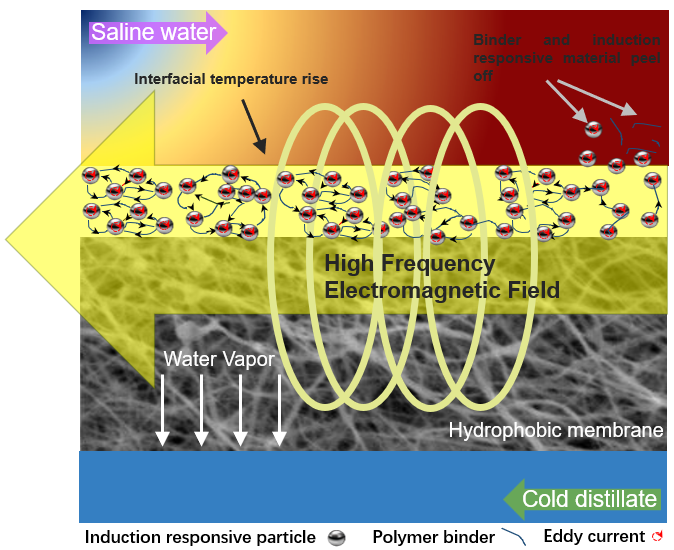
Induction-heated membrane distillation (IH-MD) has emerged as a promising interfacial-heating desalination strategy capable of reducing bulk thermal losses by localizing heat generation near the membrane surface. Compared with conventional membrane distillation, IH-MD offers the potential for improved thermal utilization and rapid interfacial vapor generation under low-grade or electrically driven heating conditions. However, practical implementation of IH-MD remains limited by membrane wetting, inorganic scaling, organic fouling, and uncertainties in long-term material stability and energy-delivery efficiency. This dissertation first investigates the design of Fe₃O₄/PANI/FAS-coated omniphobic membranes for induction-heated membrane distillation. A conductive Fe₃O₄/PANI interlayer was introduced as an induction-responsive heating domain, while fluorinated FAS grafting provided low-surface-energy omniphobic functionality. The results demonstrated significantly enhanced resistance against surfactant-induced wetting, gypsum scaling, and organic fouling under challenging feed conditions. Comparative asymmetric-flow and equal-flow experiments further revealed the progressive evolution of SDS-induced wetting from early-stage partial pore intrusion to severe pore flooding. COMSOL simulations confirmed that induction heating generated highly localized interfacial thermal zones while maintaining strong feed–permeate temperature gradients. The dissertation further examines broader challenges associated with IH-MD systems, including induction-material degradation, corrosion, binder instability, and inconsistencies in reported thermal-efficiency metrics. This work is funded by the United States Department of the Interior via the Bureau of Reclamation (Agreement number: R19AC00107 and R22AC00433) and the U.S. EPA (Assistance Agreement No. SU84014901).