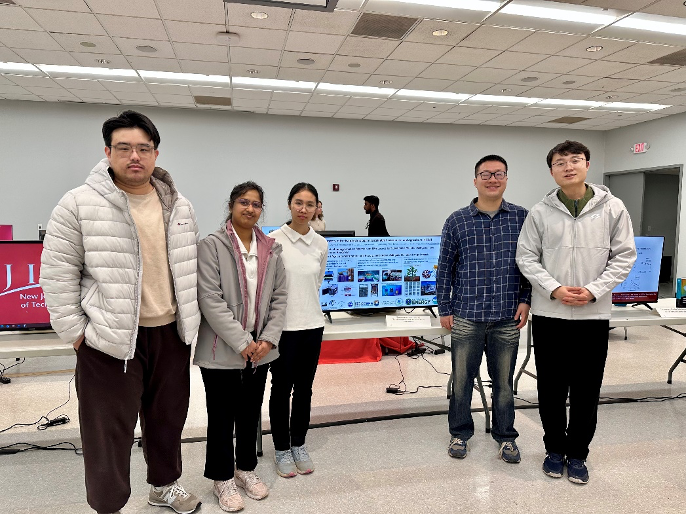
On March 4, 2026, Wen Zhang’s research group participated in the NJIT 2026 Institutes, Centers & Laboratories Showcase, which featured over 30 multidisciplinary research institutes, centers, and labs representing NJIT’s most promising engines of innovation. This showcase was organized as part of NJIT’s 2030 strategic plan to make NJIT an innovation nexus, strengthen interdisciplinary collaboration, promote technology development, and translate research into entrepreneurship for societal and economic impact. During this event, Ph.D. students and postdocs from the Zhang group presented the research areas and notable achievements of the Laboratory of Nanotechnology in Sustainable Environment and Agriculture (NiSEA) to a diverse audience of NJIT staff, faculty, students, and local stakeholders. The present members included:
Dr. Nguyen Nhat Thu Le, an environmental microbiologist whose works focused on the impacts of nanobubbles on bacterial biofilms and soil microbiomes, as well as Life Cycle Assessment of emerging technologies;
Dr. Jing-an Lin, who specializes in membrane processes, environmental remediation, and COMSOL simulation of water transport and pollutant adsorption through different media;
Guangyu Zhu, who studies desalination using induction-heated membrane distillation, focusing on interfacial heating and omniphobic membrane engineering to improve resistance to wetting, scaling, and fouling in challenging water treatment environments;
Jiahe Zhang, who introduced his research on electrochemical technologies for sustainable wastewater treatment and resource recovery, as well as atomic force microscopy (AFM)-based nanoscale characterization to understand catalytic interfaces and electrochemical processes (LinkedIn, Google Scholar);
Sowmya Atukuri, who studies nanobubble-enabled remediation processes, including oil–soil treatment, oil–water separation, and Colloidal behavior of nanobubbles in environmental systems;
Yining Zhang, who studies sustainable agriculture and advanced water and soil treatment technologies, which involves the application of innovative tools such as nanobubbles, hydrogels, and 3D scanning technologies to improve environmental monitoring and agricultural sustainability.
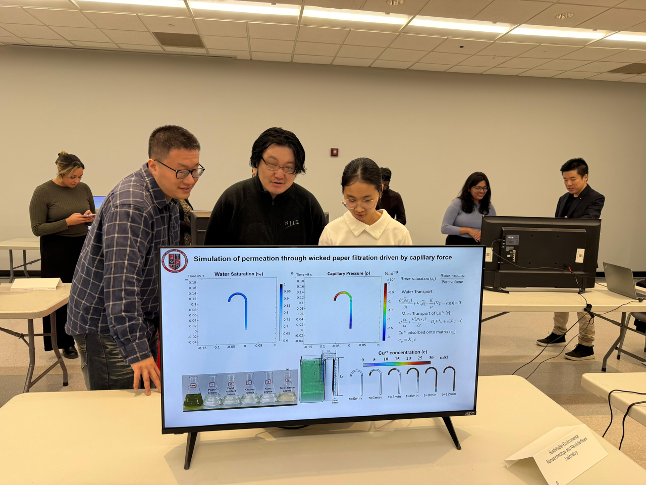
The showcase also featured a Distinguished Keynote Presentation from Mike Brizek, Ph.D., Higher Education Ecosystems Program Director from Venture Well. His talk elucidates the present challenges and strategies for Promotion and Tenure Innovation and Entrepreneurship (PTIE) in Academia, which represents a national, NSF-supported effort to reimagine how universities recognize and reward faculty impact by elevating innovation and entrepreneurship (I&E) alongside traditional scholarship within promotion and tenure systems.
Through this event, the Zhang group was able to connect to and exchange ideas with researchers and innovators from multiple disciplines, including nanoelectronics, biomedical engineering, material analysis, and machine learning. Participation in this event also reflects the group’s commitment to building new partnerships and connecting fundamental research with technological translation and social impacts. In particular, the group showcased recent advances in electrochemical technologies for environmental applications, including catalyst-enabled electrochemical systems for pollutant removal and resource recovery from wastewater. These efforts highlight the potential of integrating advanced materials, electrochemical engineering, and nanotechnology to develop sustainable solutions for water treatment and environmental protection.
