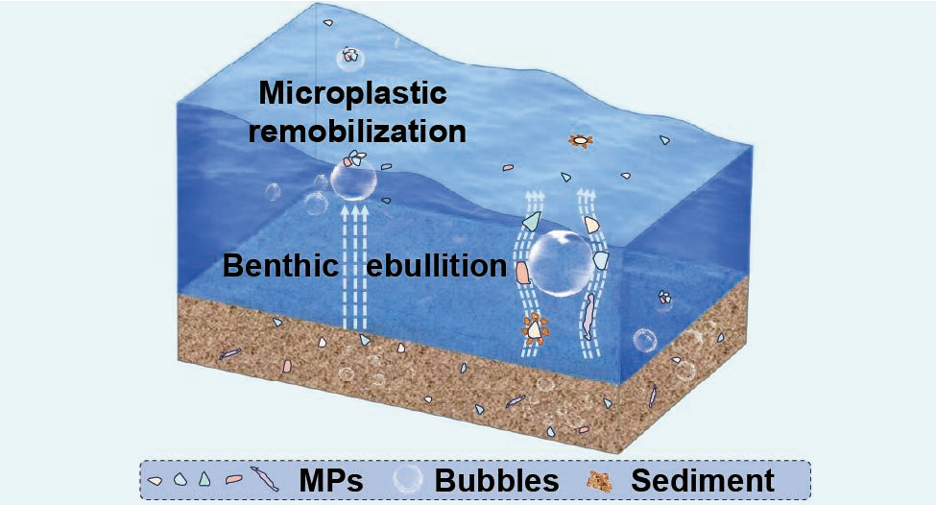
A new study published in Environmental Science & Technology reveals that benthic gas ebullition—the natural release of gas bubbles from aquatic sediments—can remobilize buried microplastics and transport them back into overlying water.
The paper, “Ebullition-Enhanced Release of Microplastics from Aquatic Sediment to Overlying Water: An Overlooked Transport Pathway,” is the culmination of a research effort that began around 2019 through collaboration between researchers at NJIT and Prof. Yang Li’s group at Beijing Normal University.
The study challenges the conventional view of aquatic sediments as a largely permanent sink for microplastics. While wastewater discharge, surface runoff, atmospheric deposition, and sediment resuspension are commonly considered in microplastic transport, the role of naturally generated gas bubbles in remobilizing buried plastic particles has received far less attention.
From an idea to a multiyear investigation
The initial concept emerged before the COVID-19 pandemic, when the research team began asking whether bubbles generated within sediments could act as a natural transport mechanism for deposited microplastics. The project subsequently evolved through multiple rounds of experimental design, mechanistic testing, theoretical analysis, numerical simulation, and manuscript revision.
Co-first author Shengdong Liu, then a master’s student at Beijing Normal University, conducted much of the experimental work as part of his graduate research and continued contributing to the study for several years after graduation. The final publication reflects a sustained collaboration spanning experimental environmental engineering, colloid science, interfacial chemistry, and transport modeling.
A coupled mechanism for microplastic remobilization
The research combined controlled sediment-column experiments, eDLVO interaction-energy analysis, particle flotation calculations, microplastic characterization, and COMSOL multiphysics simulations.
The results indicate that ebullition can promote microplastic transport through several coupled mechanisms. Rising bubbles can interact directly with plastic particles, while bubble motion disturbs the sediment–water interface and generates local flow circulation capable of entraining suspended particles and microplastic–sediment aggregates. Within the sediment, gas generation also produces transient pressure gradients that drive upward pore-water advection, progressively shifting buried microplastics toward the sediment surface.
Broader implications for microplastic cycling
The work highlights the need to consider natural benthic processes when evaluating the long-term fate of microplastics in rivers, lakes, reservoirs, wetlands, and other aquatic environments.
Other processes—including bioturbation by worms, crustaceans, benthic organisms, and swimming animals—may also contribute to sediment disturbance and microplastic remobilization. The present study specifically identifies gas ebullition as an important physical mechanism that has largely been overlooked in existing conceptual models of microplastic cycling.
The findings suggest that understanding the environmental fate of microplastics requires looking beyond their initial deposition into sediments and considering the dynamic processes that may later return them to the water column.
Read the paper:
Ebullition-Enhanced Release of Microplastics from Aquatic Sediment to Overlying Water: An Overlooked Transport Pathway, Environmental Science & Technology
https://doi.org/10.1021/acs.est.6c06432
Leave a Reply