The 2026 New Jersey Site Remediation Conference is a two-day event (March 25–26, 2026) focused exclusively on-site remediation in New Jersey. It brings together licensed site remediation professionals, regulators, consultants, and industry experts to discuss evolving regulatory frameworks, emerging contaminants, innovative remediation technologies, and professional practice issues. The conference features technical sessions, regulatory updates, professional development courses for continuing education credits, and opportunities for collaboration among environmental professionals and solution providers.
A total of four students from Dr. Wen Zhang’s research group at the New Jersey Institute of Technology (NJIT) participated in the conference, with one delivering an oral presentation and three competing in the student poster session. Their work spanned membrane science, nanobubble technologies, and resource recovery.
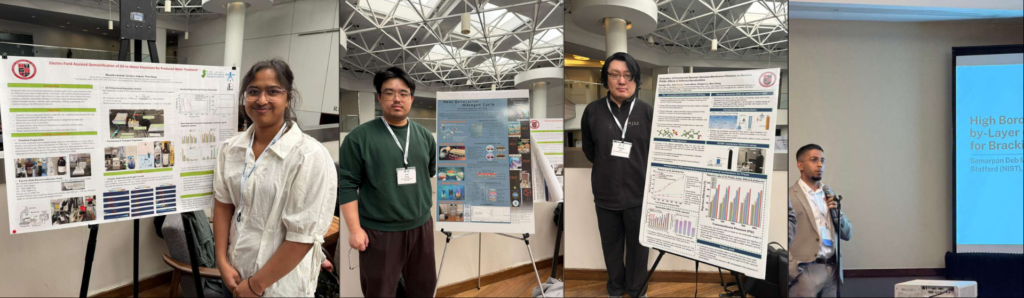
From left: Sowmya Atukuri, Jiahe Zhang, Guangyu Zhu, and Samarpan Deb Majumder
Sowmya Atukuri, who won the student poster competition, presented her work titled “Electro-Coalescence of Oil Droplets: Integrated Microfluidics and Electrochemical QCM for Oil–Water Separation.” Her study demonstrated a unique approach combining microfluidic platforms with electrochemical quartz crystal microbalance (QCM) techniques to enhance oil–water separation efficiency.
Jiahe Zhang presented an electrochemical membrane system for ammonia recovery from wastewater, achieving 99.9% nitrate removal and high-efficiency ammonia production with reduced energy input.
Guangyu Zhu presented a study on PFAS rejection in RO and NF systems, demonstrating that surfactants, ion valency, and temperature significantly influence PFAS transport and removal efficiency.
Samarpan Deb Majumder delivered a 30-minute oral presentation titled “High Boron Rejection Rinse-Free Molecular Layer-by-Layer (mLbL) Reverse Osmosis (RO) Membranes for Brackish Water Desalination and Remediation” in the emerging contaminants session. The work demonstrated that mLbL membranes can achieve over 90% boron rejection without requiring pH adjustment, highlighting their potential for energy- and chemical-efficient desalination processes.
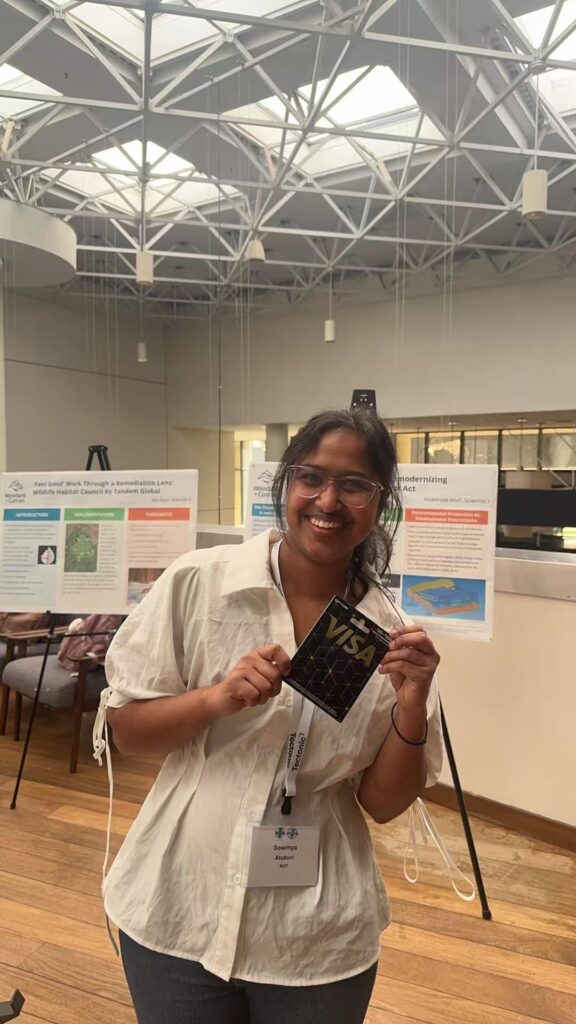
Sowmya Atukuri, winner of the poster presentation