We’re excited to share that our latest work, “Soil chemistry and microbiome modulation through water irrigation containing oxygen, hydrogen, and carbon dioxide nanobubbles”, has been published in Applied and Environmental Microbiology!
🔬 First author: Dr. Nguyen Nhat Thu Le
🏫 Corresponding author: Dr. Wen Zhang
🔗 https://journals.asm.org/doi/10.1128/aem.02173-25
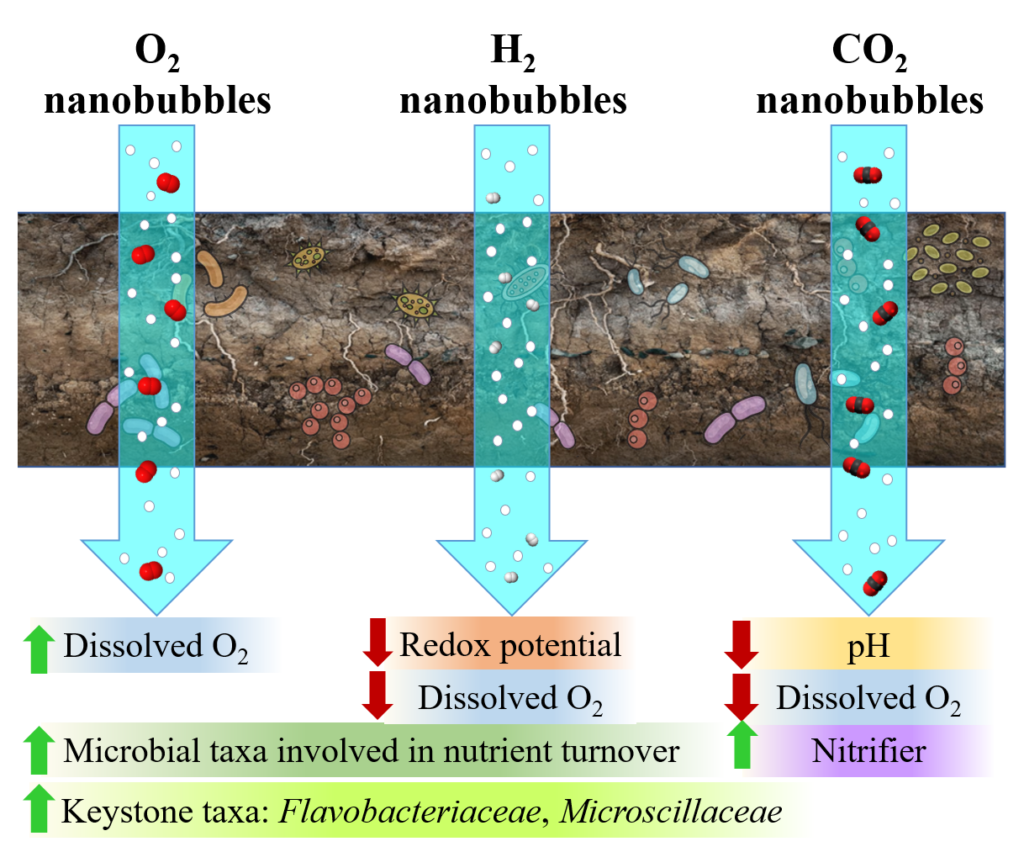
In this study, we systematically evaluated how irrigation with nanobubble-enriched water influences soil chemistry and microbial communities over time. Soils were treated with water containing oxygen, hydrogen, or carbon dioxide nanobubbles over a four-week period, with weekly sampling for microbial 16S rRNA gene sequencing and community analysis. The results show that nanobubbles with different gas cores created distinct soil microenvironments by altering key parameters such as dissolved oxygen, pH, and redox potential, which in turn drove divergent microbial responses. Notably, soils treated with oxygen and hydrogen nanobubbles exhibited enrichment of microbial taxa associated with nutrient cycling, organic matter turnover, and pathogen suppression, including Flavobacteriaceae, Comamonadaceae, Nannocystaceae, and Blastocatellaceae. These compositional shifts were accompanied by increases in metabolic pathways linked to pollutant degradation and organic substrate utilization. In contrast, carbon dioxide nanobubbles produced more limited effects on soil microbial structure. Network analysis further underscored the role of nanobubbles in strengthening keystone taxa such as Flavobacteriaceae, which are central to soil ecosystem function. Together, these findings highlight nanobubble irrigation as a promising and scalable strategy for targeted microbiome engineering, with potential applications in sustainable agriculture and environmental management.
This work was partially supported by the United States Department of Agriculture (USDA) National Institute of Food and Agriculture AFRI project grants (2019-67021-29450 and 2024-67021-42716).