The 2026 New Jersey Site Remediation Conference is a two-day event (March 25–26, 2026) focused exclusively on-site remediation in New Jersey. It brings together licensed site remediation professionals, regulators, consultants, and industry experts to discuss evolving regulatory frameworks, emerging contaminants, innovative remediation technologies, and professional practice issues. The conference features technical sessions, regulatory updates, professional development courses for continuing education credits, and opportunities for collaboration among environmental professionals and solution providers.
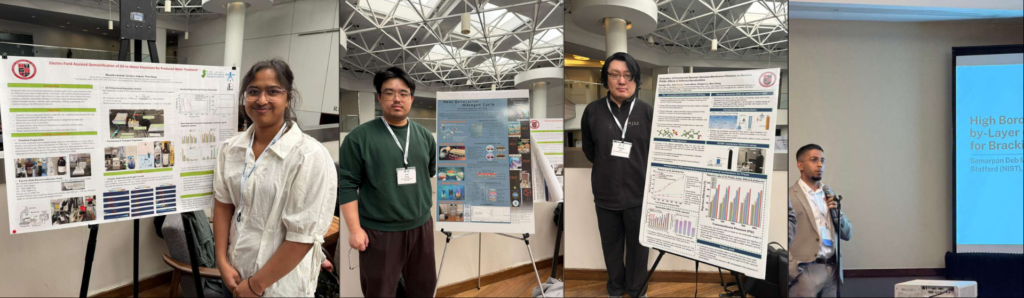
A total of four students from Dr. Wen Zhang’s research group at the New Jersey Institute of Technology (NJIT) participated in the conference, with one delivering an oral presentation and three competing in the student poster session. Their work spanned membrane science, nanobubble technologies, and resource recovery.
From left: Sowmya Atukuri, Jiahe Zhang, Guangyu Zhu, and Samarpan Deb Majumder
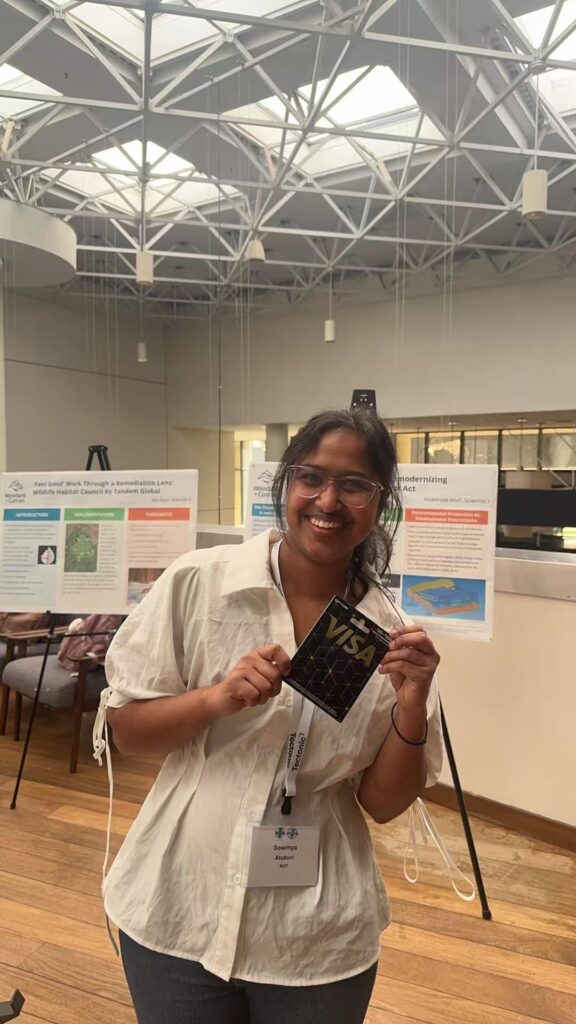
Sowmya Atukuri, who won the student poster competition, presented her work titled “Electro-Coalescence of Oil Droplets: Integrated Microfluidics and Electrochemical QCM for Oil–Water Separation.” Her study demonstrated a unique approach combining microfluidic platforms with electrochemical quartz crystal microbalance (QCM) techniques to enhance oil–water separation efficiency.
Jiahe Zhang presented an electrochemical membrane system for ammonia recovery from wastewater, achieving 99.9% nitrate removal and high-efficiency ammonia production with reduced energy input.
Guangyu Zhu presented a study on PFAS rejection in RO and NF systems, demonstrating that surfactants, ion valency, and temperature significantly influence PFAS transport and removal efficiency.
Samarpan Deb Majumder delivered a 30-minute oral presentation titled “High Boron Rejection Rinse-Free Molecular Layer-by-Layer (mLbL) Reverse Osmosis (RO) Membranes for Brackish Water Desalination and Remediation” in the emerging contaminants session. The work demonstrated that mLbL membranes can achieve over 90% boron rejection without requiring pH adjustment, highlighting their potential for energy- and chemical-efficient desalination processes.
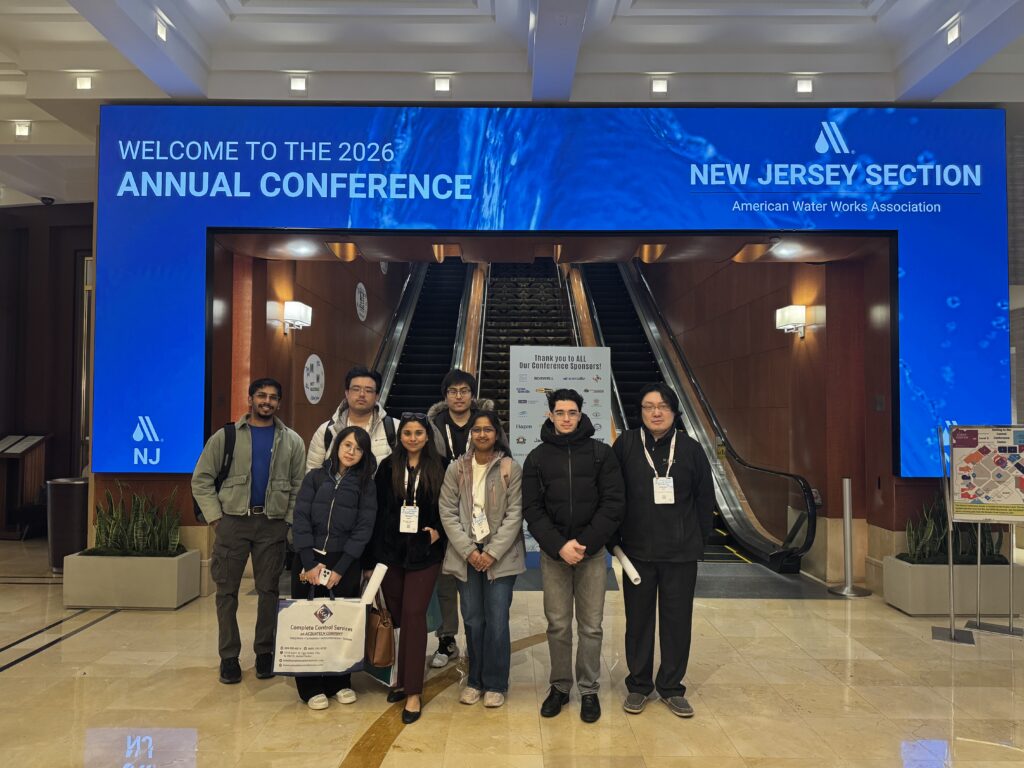
The 2026 Annual Conference of the New Jersey Section of the American Water Works Association (AWWA) was held in Atlantic City, New Jersey, bringing together researchers, industry professionals, and water treatment experts to discuss emerging challenges and innovations in water purification, and environmental sustainability. The conference featured technical sessions, industry exhibitions, and a student poster competition.
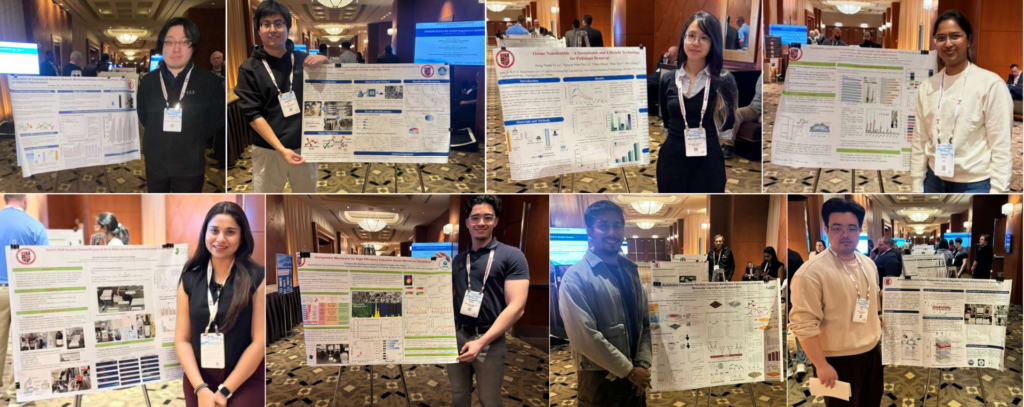
A total of eight students from Dr. Wen Zhang’s research group at the New Jersey Institute of Technology (NJIT) participated in the student poster competition, presenting research spanning membrane science, advanced oxidation, nanobubble technologies, and resource recovery.
From top left: Guangyu Zhu, Haodong Jia, Hong Thanh Vy Le, Sowmya Atukuri; bottom row: Bhumika Ganesh Kabadi, Ianmarco Guillen, Samarpan Deb Majumder, and Jiahe Zhang
Samarpan Deb Majumder, who won the poster competition, presented “Redefining Polyamide Reverse Osmosis Membrane Fabrication via Rinse-Free Molecular Layer-by-Layer (mLbL) Deposition,” demonstrating that mLbL membranes exhibit intrinsic antifouling and antiscaling properties while achieving up to fivefold higher selectivity compared to conventional RO membranes.
Jiahe Zhang presented an electrochemical membrane system for ammonia recovery from wastewater, achieving 99.9% nitrate removal and high-efficiency ammonia production with reduced energy input.
Guangyu Zhu presented a study on PFAS rejection in RO and NF systems, demonstrating that surfactants, ion valency, and temperature significantly influence PFAS transport and removal efficiency.
Haodong Jia presented copper-based catalytic systems for degradation of phenolic pollutants in high-salinity wastewater, achieving high degradation efficiencies via oxygen vacancy-driven pathways.
Sowmya Atukuri presented nanobubble-enabled foam fractionation for PFAS removal, demonstrating strong enrichment of short-chain PFAS and improved separation efficiency in complex wastewater systems.
Bhumika Ganesh Kabadi presented electric-field-assisted demulsification for produced water treatment, showing enhanced oil droplet coalescence and improved separation efficiency under applied electric fields.
Ianmarco Guillen presented an induction-heated omniphobic membrane system for desalination, achieving rapid thermal response and >99% salt rejection with enhanced resistance to scaling and wetting.
Hong Thanh Vy Le presented ozone nanobubble technology for water treatment, showing enhanced ozone stability and significantly improved pollutant degradation and antimicrobial performance.
From Treatment to Recovery represents a fundamental paradigm shift in how the water sector views saline waste streams. Rather than treating desalination brines and industrial saline effluents solely as disposal challenges, emerging electrochemical technologies now enable these streams to serve as feedstocks for valuable chemical production. In this context, we are pleased to report that our recent Environmental Science & Technology publication, “Direct Electrosynthesis and Separation Platform for Chlorine from Saline Water,” has directly led to the award of a $250,000 federal research grant from the U.S. Bureau of Reclamation under its Desalination and Water Purification Research Program (DWPR). This recognition highlights the growing importance of brine valorization, decentralized chemical production, and electrified water treatment systems for building more sustainable and resilient water infrastructure.
In the published study, we report a scalable, multilayer, flow-through electrode platform that enables the direct electrosynthesis and in-situ separation of chlorine (Cl₂) from real saline waters, including seawater and reverse osmosis (RO) brines. Unlike conventional chlor-alkali processes that rely on high-purity brines and centralized infrastructure, our system operates directly on complex waste streams, offering a pathway toward decentralized and on-site chlorine production. Key technical advances include:
Up to 97% chlorine selectivity with nearly 100% separation efficiency
Suppression of toxic oxychloride byproducts, a major environmental concern
Continuous operation enabled by a flow-through reactor architecture
Production of practically relevant sodium hypochlorite concentrations (0.53–5.1 wt%) that meet environmental discharge and reuse standards
These results demonstrate that desalination brines—traditionally treated as disposal liabilities—can instead serve as feedstocks for value-added chemical production, improving both economic viability and environmental performance of desalination and water reuse facilities.
From Chlorine Electrosynthesis to Integrated Brine Valorization
Building on this foundation, the newly awarded DWPR project expands the platform toward an integrated, electrified, membrane-free system capable of simultaneous production of chlorine and ammonia from brine wastewater. This next phase directly addresses key priorities for the water industry, including:
Reducing brine disposal impacts
Recovering critical treatment chemicals on-site
Lowering chemical transportation, storage, and safety risks
Enhancing resilience of decentralized water treatment infrastructure
The project reflects a broader shift in water research—from pollutant removal alone to resource recovery and circular water systems—and highlights how fundamental electrochemical innovations can translate into deployable technologies for utilities and industrial operators.
This work was partially supported by the NSF–BSF program (Award No. 2215387), NJ Water Resources Research Institute (Award No. G21AP10595-01), and NJIT’s Technology Innovation Translation and Acceleration (TITA) Seed Grant, with invaluable collaboration from the Yuma Desalination Plant (Arizona), which provided real RO retentate for validation under realistic operating conditions.
On December 11, 2025, the John A. Reif, Jr. Department of Civil and Environmental Engineering hosted its Annual Holiday Gathering, welcoming students, staff, and faculty for a joyful celebration to close out the year.
The gathering was filled with laughter, meaningful conversations, and a strong sense of community. Attendees enjoyed a shared meal and desserts while reconnecting with colleagues and friends in a relaxed and festive atmosphere. It was a wonderful opportunity for members of our department—from graduate students to faculty—to come together outside of classrooms and research meetings.
A highlight of the event was the delicious spread of food and desserts, which brought everyone together around the table and added to the warmth of the celebration. Moments like these remind us that our department is not only a place of academic excellence, but also a supportive and welcoming community.
We are grateful to everyone who participated and helped make this year’s Holiday Gathering such a success. Events like this strengthen the connections across our department and reflect the collaborative spirit that defines our CEE community.
We wish everyone a joyful holiday season and look forward to another year of learning, research, and shared achievements.
We proudly congratulate our former Ph.D. student Dr. Jianan Gao at The New Jersey Institute of Technology (NJIT) who has been named the winner of the “Cost-Effective Wastewater Treatment Technologies” track of the 2025 Global Prize for Innovation in Water (GPIW). His award-winning innovation—a climate-smart electrocatalytic membrane system that converts nitrate pollution into value-added ammonium salt fertilizer—represents a major advancement in sustainable water treatment and resource recovery. This breakthrough addresses two global challenges simultaneously: mitigating nitrate contamination and producing clean fertilizer with reduced environmental impact.
Dr. Gao’s research builds on a multi-year effort in the Wen Zhang Research Group to integrate electrosynthesis, membrane science, and circular-economy principles into next-generation water treatment technologies. The work has been substantially supported by the NJIT Technology Innovation Translation and Acceleration (TITA) Seed Grant program, which empowers faculty and students to accelerate innovation toward commercialization. Established in 2022, the TITA program—now expanded through NSF’s Accelerating Translational Research (ART) initiative—supports intellectual property development, market validation, industry engagement, and entrepreneurial training. It plays a crucial role in building NJIT’s growing ecosystem for translational research and technology-driven economic development.
The project also benefited from external funding sources that advanced the scientific foundation and early-stage proof-of-concept development:
NSF–BSF Award #2215387 – Electrified Membrane System for Chemical-Free Nitrogen Recovery from Nitrate-Contaminated Water ($450,000; 2022–2025).
New Jersey Water Resources Research Institute (NJWRRI) Award #G21AP10595-01 – Electrochemically Reactive Membrane System for Simultaneous Nitrate Reduction and Ammonia Recovery ($5,000; 2022–2023).
NSF I-Corps Hub, Northeast Region. Company name: RePleNish. Total: $3,000. Start-End Date: June 5, 2023 to August 5, 2023
These investments helped lay the groundwork for the innovative electrocatalytic process recognized by GPIW—a system that not only treats nitrate-laden wastewater but also transforms pollutants into high-purity ammonium products that can directly support agricultural productivity.
NJIT congratulates Dr. Jianan Gao on this prestigious global recognition and celebrates the collaborative support that made this climate-smart innovation possible. His achievement highlights NJIT’s growing leadership in water innovation, sustainable resource recovery, and translational research aimed at protecting water quality and strengthening environmental resilience.
Wen Zhang’s research group participated in the 2025 NJIT research day, held November 25 at the Campus Center, presenting five posters that highlighted the team’s latest advances in sustainable water and agricultural systems, spanning from nanobubble-assisted agriculture, microplastics monitoring, electrochemical nitrogen recovery, to advanced oxidation for high-salinity wastewater.
Guangyu Zhu showcased a Raman-based workflow for identifying and quantifying microplastics in food and agricultural wastes, combining robust spectroscopy with AFM mapping to track polymer types and particle distributions in real-world waste streams.
Jiahe Zhang reported on an integrated tunable electrochemical system for recovering ammonia from nitrate-rich wastewater, emphasizing a three-phase electrified membrane that couples nitrate removal, gas-phase ammonia extraction, and energy-efficient nitrogen upcycling.
Yining Zhang presented a study on nanobubble-enriched hydrogels for sustainable agriculture, demonstrating how nitrogen nanobubble water and hydrogels can boost plant growth and chlorophyll accumulation under limited water conditions.
Sowmya Atukuri shared work on the colloidal behavior of nanobubbles in oil–water systems and their applications in soil remediation, illustrating how nanobubble technology can enhance contaminant dispersion and provide an eco-friendly alternative to conventional soil cleanup methods.
Haodong Jia presented new results on oxygen vacancy-rich copper-based layered catalysts for peroxymonosulfate (PMS) activation under high salinity, revealing a singlet-oxygen-dominated non-radical pathway that maintains high degradation performance across broad pH and salt conditions.
Posters:
Raman-Based Identification and Quantification of Microplastics in Food and Agricultural Wastes
This poster presents a validated Raman spectroscopy workflow for detecting and quantifying microplastics (MPs) in complex food and agricultural waste matrices. The protocol combines sample digestion, density separation, membrane filtration, optical/fluorescence screening, and Raman point spectra plus micro-mapping to confirm polymer identity. Using 53 representative waste samples across five categories (including food scraps, manure, silage, sawdust, and yard waste), the study reports MP abundances of roughly 0.09–4.44 particles·g⁻¹ and surface densities of 0.34–1.03 particles·cm⁻². EVA emerged as the dominant polymer, with additional EAA, PE, VC/VAC, PS, and PA signatures. Cost and scalability analysis suggests that this workflow can support large-scale monitoring of microplastics in food and agricultural value chains.
Ammonia Recovery from Wastewater using Integrated Tunable Electrochemical Systems
This poster describes an electrochemical redesign of the nitrogen cycle that converts nitrate-rich wastewater into valuable ammonia with minimal chemical input. The core module is a three-phase electrified membrane that simultaneously enables nitrate reduction, interfacial pH modulation, and gas-phase NH₃ extraction at a single cathodic interface. The flow-cell design proceeds through three main steps: electrochemical nitrate reduction, ammonia gas diffusion through a hydrophobic layer, and subsequent ammonium ion formation in a trap chamber. Pilot-scale tests treating real industrial wastewater with ~2% nitrate achieved stable nitrate removal with an energy demand of only about 5–6 kWh·kg⁻¹ N removed and an estimated cost of $1.0–$1.6 per kilogram, demonstrating a scalable, low-carbon alternative to conventional denitrification and Haber–Bosch ammonia production.
Nanobubble-enriched hydrogels for sustainable agriculture: enhancing water and nutrient delivery to boost plant growth
This poster introduces a dual-technology irrigation strategy that integrates nitrogen nanobubble (NB)-enriched water with agricultural hydrogels to improve kale growth under controlled irrigation. The team compared tap water, nanobubble water, hydrogel, and hydrogel–nanobubble combinations, monitoring fresh weight, leaf water content, and chlorophyll a/b. Results show that nitrogen nanobubble water consistently increased biomass, while hydrogel–nanobubble treatments further enhanced chlorophyll accumulation. Although hydrogel alone reduced fresh weight under tap-water irrigation, their performance improved significantly when paired with nanobubbles. The work highlights nanobubble-infused hydrogels as a promising, resource-efficient approach for water retention, nutrient delivery, and sustainable crop production.
Colloidal Behavior of Nanobubbles and Applications in Oil Dispersion and Soil Remediation
This poster explores nanobubble water technology as an eco-friendly option for oil dispersion and soil remediation. Using both a pressurized membrane-bubble circulation mode and a direct injection mode, the study generates micro- and nanobubbles and examines how they interact with gasoline and soil matrices. Measurements of gasoline concentration in oil and water layers show that nanobubble treatment slightly decreases the oil-phase concentration while enhancing transfer of gasoline into the water phase, indicating improved dispersion at the interface. Micro-nanobubbles remained stable over time, with bubble sizes increasing from roughly 140–180 nm to about 220–230 nm in later weeks, and oil removal efficiency was sensitive to surfactant concentration and exposure duration. Overall, the work demonstrates that tuning nanobubble properties can promote contaminant mobilization and offers a promising, chemical-lean alternative to conventional soil and groundwater remediation methods.
Oxygen Vacancy-Rich Copper-Based Layered Catalysts for Efficient Phenolic Pollutant Degradation via Peroxymonosulfate (PMS) Activation under High Salinity
This poster reports the development of a copper-based layered catalyst rich in oxygen vacancies (Ov) for activating PMS to degrade refractory organics in high-salinity wastewater. Structural engineering with urea-derived reductive gases generates abundant Ov sites that favor a singlet-oxygen (¹O₂)-dominated non-radical pathway resilient to inorganic ions. In 200 mM salt solutions, the catalyst achieves >80% phenol removal and >90% degradation of multiple phenolic pollutants over a wide pH range (3–11). Quenching experiments and XPS/EPR analyses confirm the key role of Ov and Cu(I) in driving non-radical PMS activation. The material exhibits strong durability, retaining >80% activity after repeated cycles, and offers an efficient, ion-resistant strategy for treating high-salinity organic wastewater.
The NJIT Wen Zhang’s research group participated in the 2025 Eastern Analytical Symposium (EAS), held November 17–19 in Plainsboro, New Jersey, presenting three posters that showcased the group’s latest analytical innovations for emerging environmental contaminants.
Sowmya Atukuri presented a study on nanobubble characterization using Nanoparticle Tracking Analysis (NTA) and Dynamic Light Scattering (DLS), demonstrating improved size and concentration calibration across aqueous and organic matrices.
Guangyu Zhu introduced a Raman-based workflow for the identification and quantification of microplastics in food and agricultural wastes, emphasizing matrix effects, spectral reliability, and large-scale applicability across diverse waste streams.
Jiahe Zhang presented new results on PFAS occurrence and bioaccumulation risks in food waste, along with a detailed cost assessment of detection workflows using advanced LC-QQQ methods.
Posters:
Nanobubble Characterization using Nanoparticle Tracking Analysis (NTA) and Dynamic Light Scattering (DLS)
This poster presents improved analytical strategies for accurately measuring nanobubble size and concentration in complex liquid systems. Using NTA and DLS, the work establishes calibration curves with 100 nm and 200 nm polystyrene standards across both aqueous and organic media. The study demonstrates reliable particle size distribution, zeta potential measurements, and concentration quantification, highlighting how liquid matrices influence stability and detection sensitivity. These findings contribute to advancing nanobubble research in environmental and biochemical applications by improving measurement reproducibility and QA/QC reliability.
Raman-Based Identification and Quantification of Microplastics in Food and Agricultural Wastes
This poster introduces a validated Raman spectroscopy workflow for detecting and quantifying microplastics in a wide range of food and agricultural waste matrices. The method integrates sample digestion, density separation, membrane filtration, and spectral micro-mapping to identify polymer types and particle distributions. Results from 53 representative waste samples reveal polymer composition trends, matrix influences, and particle abundance ranges. The workflow demonstrates robustness, spectral reliability, and cost-effective scalability, supporting large-scale environmental monitoring and improving understanding of microplastic contamination in complex waste streams.
Per- and Polyfluoroalkyl Substances (PFAS) in Food Waste: Detection and Cost Analysis
This poster reports new findings on the occurrence and distribution of PFAS in food waste from restaurants, schools, landfills, and commercial fish fillets. Using EPA Method 1633 and LC-QQQ quantification, the study identifies 25 PFAS compounds and highlights bioaccumulation risks in fish tissue. The work also evaluates the cost of PFAS detection workflows (USD 500–1300 per sample), providing insight into practical monitoring requirements. By integrating PFAS extraction, cleanup, and advanced analytics, this research supports sustainable waste management and informs regulatory and community-based monitoring strategies.
Together, these three poster contributions underscore the group’s ongoing commitment to advancing analytical methodologies for complex environmental systems. By integrating cutting-edge characterization tools with real-world applications, the Wen Zhang Research Group continues to expand its impact in contaminant detection, environmental monitoring, and sustainable waste management. We look forward to further collaborations, conference engagements, and research advancements in the coming year.
ISO TC281 committee chair, Dr. Nobuhiro Aya, visited the NJIT campus and toured our laboratory to discuss planning logistics for the 2026 International Nanobubble Conference and the accompanying ISO committee meeting to be held at NJIT.
During the visit, Dr. Aya met with our research team, reviewed ongoing projects, and examined several poster presentations showcasing recent advances in nanobubble and nanodroplet science. The tour provided an excellent opportunity to exchange ideas and ensure smooth coordination between the conference organizers and ISO leadership.
We are proud to share that Oluwanifemi Fuwa, an undergraduate researcher at New Jersey Institute of Technology (NJIT), presented her cutting-edge work on airborne virus inactivation at the 2025 NCHC Annual Conference, themed “Charting Partnerships and Collaborations to Inspire Honors” in San Diego, CA, November 6–9, 2025.
Oluwanifemi presented our collaborative project titled “High-Efficient Inactivation of Airborne Viruses Using a Microwave-Enabled Air Filtration System,” developed with faculty advisor, Dr. Wen Zhang, and Ph.D. student, Fangzhou Liu. This innovation aims to tackle virus transmission in shared spaces such as hospitals, trains, and classrooms by integrating microwave-catalytic coatings into commercial air filters to boost viral removal efficiency without chemicals.
The research—supported by funding from NSF, NJDEP, NJEDA, and the NJIT Technology Innovation Translation and Acceleration (TITA) Seed Grant—demonstrated significant enhancements in virus removal through catalytic heating and nanobubble formation.
We’re excited to share that our viewpoint article, “Reframing Induction-Heated Membrane Distillation: From Flux Enhancement to Durable, Energy-Efficient Design,” has been published in ACS ES&T Engineering.
Induction-heated membrane distillation (IH-MD), a rapidly developing interfacial-heating desalination approach that couples electromagnetic fields with magnetically responsive coatings to deliver localized heat at the membrane interface, can significantly boost vapor generation. However, its long-term viability has been limited by material instability under hypersaline and oxidative conditions, as well as inconsistent methods for quantifying how much power reaches the membrane surface. Our study synthesizes these material and durability challenges and introduces a unified energy-accounting framework that distinguishes power delivery from power utilization. By incorporating a delivered-power coefficient (κ) together with thermal efficiency (TE), this framework improves transparency in comparing IH-MD performance across different materials, chemistries, and system designs. We also highlight the need for standardized reporting—covering delivered/coupled power, heated area, time-averaged flux, and durability testing to support reproducible progress and guide the development of IH-MD systems. The work is supported by the U.S. Bureau of Reclamation (Grant R22AC00433).